




Choosing between a catamaran and a monohull is one of the most consequential decisions you will make for any sailing project, whether you are planning a charter holiday, considering a purchase, or preparing a long-distance passage.
Both designs have real strengths and real limitations, and the right answer depends entirely on how you sail, where you sail, and who is coming with you.
This guide covers every dimension that actually matters, with honest assessments on both sides.
Quick comparison: catamaran vs monohull at a glance
Before diving into the detail, here is a side-by-side overview of the main differences between catamarans and monohulls across the dimensions that matter most to sailors and charterers.
| Dimension | Catamaran | Monohull |
| Stability / heeling | Stays essentially flat (3 to 5 degrees maximum) | Heels naturally under sail, part of the experience |
| Speed downwind / reaching | 20 to 30% faster than an equivalent monohull | Slower off the wind |
| Speed upwind | Less efficient, makes more leeway | Points higher, better windward performance |
| Living space | Significantly more at equivalent overall length | More compact; cabin life at an angle underway |
| Rough sea behaviour | Wave slamming under bridgedeck; hobby-horse pitching possible | Cuts through waves; more predictable motion |
| Safety / capsize | Very hard to capsize, but does not self-right if it does | Can capsize but self-rights thanks to ballast keel |
| Draft | Shallow (approx. 1 m): access lagoons and beaches | Deeper keel: limited in very shallow anchorages |
| Marina fees | 1.5 to 2x more expensive per berth due to beam | Standard marina pricing |
| Purchase price | Higher for equivalent size and specification | More accessible across all budget levels |
| Manoeuvrability under sail | Slower to tack; can stall mid-tack in light air | More agile, tacks cleanly and quickly |
| Docking under engine | Excellent: twin engines allow pivot-in-place | Standard single-engine docking |
| Sailing feel | Comfortable, stable platform; less connected to the wind | Visceral and tactile: you feel every gust and wave |
| Best suited for | Families, charters, liveaboards, coastal and island cruising | Performance sailors, purists, offshore passages |
What is the difference between a catamaran and a monohull?
A quick reminder on what a monohull is in a nutshell
A monohull is any boat built on a single hull. Its stability comes from a ballast keel, a heavy weighted fin mounted below the waterline that keeps the boat upright by lowering its centre of gravity.
The deeper and heavier the keel, the more the boat resists heeling, but also the greater the draft.
The definition (and meaning!) of a catamaran
A catamaran has two separate hulls joined by a bridgedeck structure.
Because the hulls are spaced wide apart, the boat achieves stability through width rather than weight. There is no ballast keel, which makes catamarans significantly lighter than equivalent monohulls, and that weight saving is a large part of why they are faster downwind.
It also means the draft is dramatically shallower, typically around one metre, compared to two metres or more for a keelboat of similar length.
This single design difference, keel versus beam-based stability, drives almost every other tradeoff covered in this article: speed, motion at sea, safety behaviour, space, and cost. Which is why we need to go deeper here so that you can understand the details that will follow.
How a catamaran achieves stability without a keel
A 45-foot catamaran is typically around 22 feet wide. That wide base makes it extremely resistant to rolling. In calm to moderate conditions, a cat rarely heels beyond three to five degrees, even with full sail up.
The stability is structural and geometric, not ballast-dependent, which is why you can walk across the deck while underway without bracing against a constant lean.
Why the keel defines the monohull experience
On a monohull, the keel creates a pendulum effect.
As the wind loads the sails, the boat heels to find its natural sailing angle, often 20 to 30 degrees in a good breeze. This is not a flaw: it is how the boat is designed to work. The heel feeds information to the helm, signals when the boat is overpowered, and produces the connected, physical sensation that many sailors find irreplaceable.
The keel also serves a critical safety function: if a monohull is knocked down or capsized, the ballast will right the boat. This self-righting ability has important implications in extreme weather, which we will cover in the rough seas section below.
Are catamarans faster than monohulls?
In most conditions encountered during cruising, yes.
A performance cruising catamaran is typically 20 to 30% faster than a comparable monohull on downwind and reaching points of sail. The reasons are straightforward: no heavy keel dragging through the water, reduced displacement overall, and two narrow hulls generating far less wetted surface drag than one deep-draft hull of equivalent volume.
That said, raw boat speed figures can be misleading if you look at them in isolation.
Downwind and reaching: where catamarans dominate
On a broad reach or a run, the catamaran’s lightweight, wide-beam platform comes into its own.
In 15 to 25 knots of breeze with sheets eased, a well-sailed cat will leave a similarly sized monohull behind. This is the point of sail that covers most of the miles on a Caribbean trade wind passage or a Mediterranean summer cruise, and it is where the catamaran’s speed advantage is most consistent and most meaningful in practice.
Performance-oriented builders like Outremer and Catana push this further with daggerboards and optimised hull shapes, producing catamarans that can average well above typical monohull cruising speeds over long passages.
For most production charter cats, the advantage is more modest but still real. You can read more about downwind versus upwind sailing dynamics if you want to understand the point-of-sail picture more deeply.
Upwind: why monohulls often arrive first when beating
Upwind, the picture reverses in important ways.
Monohulls generally point higher into the wind, meaning they can sail a more direct course when beating to windward. Catamarans without daggerboards make more leeway, sliding sideways even as they move forward, which forces a wider tacking angle and more distance covered to reach an upwind destination.
In practical terms, a catamaran that is technically 25% faster in boat speed may cover 15 to 20% more distance going upwind than a monohull on the same route. The net result is that the speed advantage largely cancels out when beating, and in some conditions the monohull actually arrives first.
High-performance cats fitted with daggerboards (Outremer, Catana ocean class) are genuine exceptions, but these are not the boats most charterers will encounter.
Stability and seasickness: which is actually better between a cat and a monohull?
This is one of the most searched questions in the catamaran versus monohull debate, and it deserves a more nuanced answer than the usual “catamarans are better” shortcut.
Why catamarans generally cause less seasickness
For the majority of sailors, particularly non-expert crew and guests who are occasionally prone to motion sickness, a catamaran is the more comfortable platform.
The absence of heeling removes the most disorienting aspect of monohull sailing. Sleeping, cooking, and moving around the boat while underway are genuinely easier when the floor is level. The 3 to 5 degree heel of a cat is barely perceptible compared to the 25-degree lean of a monohull in a good breeze, which can make even experienced sailors feel off-balance over a long passage.
At anchor, catamarans are also notably more comfortable. Their wide beam and shallow draft mean they tend to sit more quietly, resisting wrap-around swell better than a monohull swinging on a single point.
When catamarans can actually be worse
Here is the part most catamaran enthusiasts leave out, but we don’t! We are known to be cats specialists, but let’s be honest here.
In confused or steep sea states, particularly short choppy swells on a beam reach, catamarans produce a twisting, jerking motion that some people find harder to tolerate than a monohull’s steady rolling. The two hulls lift and fall independently as waves pass under them, creating a corkscrewing motion that simply does not exist on a single hull. Waves striking the underside of the bridgedeck also produce a sharp slamming noise and shock that can be genuinely startling the first time you encounter it.
Some experienced liveaboards and bluewater sailors report that seasickness was more of a problem on their catamaran than their previous monohull, specifically in non-downwind conditions. This is not the majority experience, but it is real and worth knowing before you commit to the assumption that a cat will automatically solve a seasickness problem.
The general principle holds: for a charter group with mixed sailing experience in trade wind or Mediterranean conditions, a catamaran will reduce seasickness risk considerably. For hardcore offshore sailors doing multi-day passages in variable conditions, the picture is less clear-cut.
Catamaran vs monohull in rough seas: the honest picture
This is the section where most articles online either oversimplify or pull their punches.
Both boat types behave well in rough weather when sailed correctly. But…both have genuine limitations. Just not exactly in the same areas, as you may guess.
How catamarans behave when conditions deteriorate
In heavy weather, catamarans ride above the waves rather than cutting through them. In long ocean swells this produces a smooth, fast ride that is genuinely more comfortable than most monohulls.
The problem arises when the sea state becomes steep, confused, or short-period: the bridgedeck begins to slam as waves strike it from below, the boat pitches in a hobby-horse motion as the bow buries and recovers, and the overall motion becomes tiring… and loud as we mentioned before.
There is also a sail management consideration.
On a monohull, increasing heel is an early and visible warning that the boat is overpowered. A catamaran does not heel this way, so detecting the onset of overcanvas requires more active attention from the helmsperson. This is not difficult with experience, but it is a different skill set.
You can find more on how different yacht types handle heavy weather in our dedicated guide.
The capsize question: which is safer?
This is the most important safety nuance in the entire catamaran versus monohull comparison, and it rarely receives an honest treatment.
A catamaran is extremely difficult to capsize. Its wide beam creates enormous initial stability, and it would take a combination of extreme wave action and critical sail management errors to flip a modern cruising cat. In the conditions that most sailors encounter in a lifetime of cruising, the capsize scenario is essentially theoretical.
However, if a catamaran does capsize, it stays inverted. The same wide beam that resists capsize also prevents self-righting.
A monohull, by contrast, carries all of its ballast below the waterline. If it is knocked down or capsized by a breaking wave, the heavy keel will bring it back upright. This has saved lives in extreme offshore conditions, and it is the reason why some very experienced bluewater sailors still prefer monohulls for serious ocean passages, particularly in the Southern Ocean or during North Atlantic winter crossings.
The silver lining for the catamaran is buoyancy. A capsized cat, with its sealed hulls, will float indefinitely. Survivors can take refuge on the overturned hulls while waiting for rescue. A sinking monohull offers no such margin.
For the vast majority of sailing scenarios, including the Caribbean, Mediterranean, Indian Ocean, and Pacific island hopping, neither capsize scenario is a realistic risk with competent seamanship. The choice between the two should not be driven by capsize fear alone.
For coastal and charter sailing: catamarans are the safer practical choice
For families on charter, couples cruising the Mediterranean, or anyone sailing in well-travelled, well-forecast conditions, the catamaran’s stability advantage translates directly into safer daily navigation.
A flat, stable platform means less crew fatigue, fewer falls on deck, easier man-overboard prevention, and more time for the helmsperson to focus on boat handling rather than compensating for heel.
These are not theoretical safety gains, they are practical ones that apply on every passage.
Space, comfort and living aboard: where catamarans win clearly over monohulls
At equivalent overall length, a catamaran offers dramatically more usable space than a monohull. This is perhaps the most unambiguous advantage in the entire comparison, and it is the main reason why catamarans now dominate the crewed charter market in destinations like the Caribbean and the Seychelles.
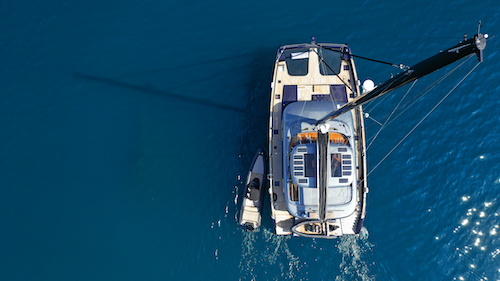

The layout advantage of a catamaran: cockpit, saloon and cabins
The structural difference that matters most for daily life aboard is that the catamaran’s main saloon sits at the same level as the cockpit.
You step in directly from the helm area without descending a companionway ladder. The galley is above the waterline with natural light and outward views. The whole living area feels open and connected to the outside rather than buried below deck.
Cabins spread across the two hulls provide genuine privacy and sound separation between groups. A 45-foot catamaran will typically offer four double cabins with private heads, each in its own hull section, while a 45-foot monohull of equivalent specification might offer three cabins with shared or cramped facilities. For groups of family or friends where privacy matters, this difference is decisive.
Add the trampoline netting at the bow, a flybridge on larger models, and wide side decks that are walkable while underway, and the catamaran simply offers a level of outdoor living space that a monohull cannot match at the same price point.
Access to the water
One of the most appreciated features of a catamaran, especially on charter, is the stern access to the sea.
The twin-hull sterns sit low to the water, making boarding a dinghy, swimming from the boat, or using water toys dramatically easier than on a monohull where the freeboard can be considerable. For families with children or guests who are not confident swimmers, this is a genuine quality-of-life difference.
What monohull sailors genuinely miss when switching to a cat
Not everything transfers. Many sailors who have spent years on monohulls describe a sense of disconnection when they first move to a catamaran.
The cockpit is smaller and more enclosed on many charter cats. The sensation of the boat responding to the wind, that physical feedback through the helm and the hull, is muted on a wide, stable platform. Below deck, the saloon of a monohull has a certain intimacy and warmth that the open, airy layout of a cat sometimes lacks on a rainy overnight passage.
None of this is a flaw, but it is a real difference in experience.
Sailors who sail because they love the act of sailing, not just the destinations, often find that standard production catamarans leave them slightly unsatisfied. The boat is comfortable; it just does not talk to you the same way.
Anchoring, draft and marina costs: the practical realities
Stability and speed are the glamorous parts of the catamaran versus monohull debate. The practical realities of where you can go and what it costs tend to matter just as much over a full season or a liveaboard life.
Shallow draft: the catamaran’s hidden advantage
Most cruising catamarans draw around one metre of water. A comparable monohull keelboat draws two metres or more. That difference unlocks an entirely different category of anchorage.
The shallow lagoons of the Bahamas banks, the beach-edge anchorages of the Caribbean, and the inner bays of Greek island groups that dry or barely cover at low tide are all accessible to a cat and simply unavailable to a deep-draft monohull.
If shallow-water cruising and direct beach access are part of your plan, the catamaran wins this comparison without contest. Our Bahamas sailing guide gives a clear sense of how critical draft becomes in that destination specifically.
Marina fees: budget for 1.5 to 2 times the cost for a cat
Marina berths are typically priced by beam, not by overall length. A 45-foot catamaran that is 22 feet wide is billed accordingly, and the result is usually 1.5 to 2 times the cost of an equivalent monohull at the same marina. Some older or smaller marinas, particularly in the Mediterranean, cannot accommodate catamarans at all due to their limited finger pontoon spacing.
In practice, this matters less than it sounds for full-time cruisers, who spend the majority of their nights at anchor rather than on a pontoon.
For charterers planning to base themselves in a marina between legs, or for owners who keep a permanent berth, the cost difference is significant and worth building into any budget calculation.
Manoeuvring under sail and engine
Under sail, the monohull is the more agile boat. It tacks cleanly and quickly, maintaining speed through the wind. A catamaran needs more boat speed to carry its momentum through a tack, and in light air it can stall mid-manoeuvre. Jibing is generally more manageable on a cat due to the wider sheeting angles, but tacking requires practice and planning, particularly in confined anchorages.
Under engine, the dynamic reverses completely.
Twin engines mounted in each hull allow a catamaran to spin on its own axis by running one engine forward and the other in reverse. Docking a cat in a marina berth is, counterintuitively, easier than docking many monohulls once you understand the principle. The two-engine manoeuvrability is one of the most practically useful features of the catamaran design for everyday harbour use.
Which is right for you: monohull or catamaran? A guide by sailing profile
There is no objectively superior choice between a catamaran and a monohull. The right answer depends on who you are, what you want from sailing, and where you are going. Here is how the tradeoffs map to the most common sailing profiles.

Families and groups on charter holidays
For a group of four to eight people where not everyone is an experienced sailor, the catamaran is what we recommend to our charter client in most instances.
The stable platform reduces seasickness risk for guests who are unused to the motion of sailing. Separate cabins across two hulls provide privacy that is simply not available on a monohull of equivalent charter price. Cooking, eating, and socialising underway are genuinely pleasant rather than a balancing act. Easy water access from the stern makes swimming stops and tender use effortless.
The catamaran was effectively designed for this use case, and it shows. Browse our crewed catamarans fleet for charter to get a sense of the designs and prices available.
Experienced sailors and performance enthusiasts
If you sail because you love the act of sailing, a monohull or a high-performance catamaran is likely the better fit.
The tactile feedback, the upwind capability, the way a well-tuned monohull accelerates through a puff and settles on its lines, these sensations are genuinely absent on most production cruising cats. Experienced sailors who charter occasionally often choose monohulls specifically because the sailing is more engaging.
For anyone who finds that a good day’s sailing means punching upwind in a building sea, the monohull remains the right answer. Discover our monohulls fleet here to have an idea of what true sailing can look like.
Liveaboards and long-distance cruisers
For a couple or family living aboard and covering serious miles, both options are well-proven and widely used.
The catamaran advantage in space, comfort, and anchorage access is significant for quality of daily life. The monohull advantage in marina access, lower operating costs, and offshore simplicity is significant for voyage planning and budget management over a multi-year project. Most liveaboard communities include both, and the right choice often comes down to budget first and preference second.
Our guide to living on a yacht covers many of the practical realities that apply to both hull types.
Offshore passage makers and ocean crossings
This is where the monohull argument carries the most weight.
Self-righting capability, better upwind performance in the variable conditions typical of offshore passages, easier single-handed or short-handed operation, and the ability to heave-to effectively are genuine advantages for serious offshore sailing. Many bluewater rally participants still choose monohulls for these reasons.
For a full guide to transatlantic yacht selection, including the monohull versus multihull considerations for a major ocean crossing, we cover the topic in detail separately.
That said, thousands of catamarans complete ocean crossings every year, including the ARC Atlantic rally. The catamaran’s trade wind downwind performance is actually well-suited to the most common ocean crossing routes.
The capsize risk, while real, remains theoretical for the vast majority of passages. Both hull types are capable of ocean sailing; the choice comes down to the individual sailor’s priorities and experience level.
See also our guide on boat size for circumnavigation for a broader perspective on hull choice for extended bluewater sailing.
The sailing experience: what you actually feel on each boat
Beyond the performance numbers and practical tradeoffs, the choice between a catamaran and a monohull is partly a philosophical one about what sailing means to you.
On a monohull, sailing is physical and immediate. The boat leans into the wind, the sails load up, the helm develops weight and feedback, and you feel the water through the hull with every wave and gust. When conditions build, the monohull telegraphs its limits clearly and rewards precise sail trim with a direct response. Sailing upwind in a good breeze on a well-set-up monohull is one of the most satisfying experiences in sailing, and it is difficult to replicate on a catamaran.
On a catamaran, sailing is fast and serene. The boat stays level as the wind increases, the wake hisses past the twin sterns, and the speed builds with a quiet efficiency that is its own kind of pleasure. There is less drama, less physical demand, and less sensation of struggle. The trade wind passage on a catamaran, sails full and the boat flying at eight or nine knots on flat water, is genuinely spectacular and accessible to crew of almost any experience level.
Neither experience is better in any absolute sense. They are different. Most sailors who have spent significant time on both will tell you the same thing: they value each for different reasons, in different conditions, for different reasons to go sailing in the first place.
Conclusion: catamaran or monohull?
Our honest answer is that both designs are exceptional, and the better choice depends on context rather than any universal ranking. The catamaran wins on space, stability, shallow-water access, downwind speed, and comfort for mixed-experience groups. The monohull wins on sailing feel, upwind performance, marina access and cost, offshore versatility, and purchase price at equivalent lengths.
For most of our charter clients, particularly families and groups wanting a comfortable, relaxed holiday with easy water access, a catamaran is the natural choice. For experienced sailors who sail for the pleasure of sailing itself, or for anyone planning serious offshore passages, we might recommend the monohull alongside the cat. Neither should be dismissed based on assumptions: the best way to decide is to sail both before committing.
If you are still unsure which hull type suits your specific project, whether a charter, a purchase, or a liveaboard plan, our team can advise based on the details of your route, crew, and budget. Get in touch and we will help you find the right boat.
You might also find it useful to compare the catamaran against a third option: our trimaran versus catamaran guide explores the differences between multihull types for those looking at the full range of modern sailing designs.
And if you are ready to browse available boats, our catamaran and trimaran charter selection covers the full fleet.
FAQ regarding differences between monohulls and catamarans
For coastal and charter sailing in normal conditions, catamarans are generally the safer practical choice due to their stability and reduced fatigue. However, the picture is more nuanced offshore. A catamaran is very hard to capsize, but if it does go over, it will not self-right. A monohull can be capsized more easily in extreme conditions, but the ballast keel will bring it back upright. For most sailors in most destinations, neither capsize scenario is a realistic concern.
A catamaran is usually the better choice if seasickness is a concern. The flat, stable platform and absence of constant heeling reduce motion sickness significantly for most people. The one caveat is that in confused, short-period seas or on a beam reach in choppy conditions, the twisting motion of a cat can also cause nausea in sensitive individuals. For a family charter in the Caribbean or Mediterranean, a cat is the safer bet by a clear margin.
Yes, typically 20 to 30% faster on downwind and reaching points of sail, which covers the majority of miles on most cruising passages. Upwind, the speed advantage largely disappears because catamarans make more leeway and sail at wider angles to the wind, which increases the distance covered. For performance sailing in all conditions, high-performance cats with daggerboards are competitive upwind as well.
Yes. Marina berths are typically priced by beam, and a catamaran’s wide beam means fees are usually 1.5 to 2 times those of a monohull of the same length. Some marinas, particularly older or smaller facilities in the Mediterranean, cannot accommodate catamarans at all. For full-time cruisers who anchor more than they use marinas, the real-world cost difference is smaller than it looks on paper.
Yes. Thousands of catamarans complete ocean crossings every year, including major rallies like the ARC. Catamarans handle open ocean swells well, and their trade wind downwind performance makes them well-suited to the most common crossing routes. The key considerations are bridgedeck clearance in steep waves, proactive sail management, and the capsize limitation in truly extreme conditions. With a competent skipper and proper preparation, a catamaran is a fully capable ocean passage maker.
A catamaran, without hesitation. The stable, flat platform dramatically reduces seasickness risk for non-sailors. Separate cabins across two hulls give every couple or pair their own space and privacy. Easy stern access to the water makes swimming and water sports effortless. The open saloon and cockpit layout means even guests who never touch a winch feel comfortable and included. For a mixed group wanting a relaxed, enjoyable sailing holiday, the catamaran is purpose-built for the job.
If you like comfort, space and travel as a family, you will likely prefer a catamaran. If you want an authentic experience, traditional esthetics and your adrenaline running high, then you will love the monohull.


%20for%20you?%20Here%20is%20what%20you%20should%20know%20before%20sailing%20one%20or%20the%20other.)