
Oil prices have lurched upward. Jet fuel costs have roughly doubled since early 2026. Some shipping corridors are actively dangerous. And yet the urge to escape on the water has never been stronger. If you’re planning a yacht charter this year or next, this guide tells you exactly which choices protect your budget, your safety, and your peace of mind and which ones quietly expose you to the chaos happening off the coast.
What’s actually disrupting yacht charters right now, and should you be worried?

While the desire for pristine beaches and exclusive anchorages remains unchanged, the logistics of getting there—and powering your vessel—have shifted significantly. A combination of geopolitical friction and economic volatility has created a tricky environment for luxury travel. However, with the right strategy, you can easily bypass the friction points.
The Middle East conflict and its ripple effect on oil and fuel prices
The ongoing instability in the Middle East has sent shockwaves through the global energy markets. For yacht charterers, this translates directly to the pump. Marine diesel prices fluctuate daily, making it incredibly difficult to predict the final cost of a high-consumption itinerary. If you are tracking expenses, these erratic spikes can turn a well-planned vacation budget into a moving target.
Private jet and airline costs: the other side of the disruption
It’s not just the boat that requires fuel. Jet fuel prices have roughly doubled since early 2026, which means getting to your embarkation port is notably more expensive. Commercial airlines have passed these costs directly to consumers, and private aviation operators have adjusted their fuel surcharges accordingly. Long-haul routing also requires navigating around restricted or sensitive airspaces, adding travel time and cost to your journey.
Which charter destinations are directly in the disruption zone, and which aren’t
Geographic positioning is everything this year. Some regions require extreme caution, while others remain completely insulated from the chaos.
| Zone | Geopolitical risk | Fuel price sensitivity | Recommended? |
| Arabian Gulf / Red Sea | High: Strait of Hormuz transit warnings, war-risk insurance required | Very high | Avoid for leisure charters |
| Mediterranean (Greece, Croatia, Turkey, France, Italy) | None: stable, no direct impact | Moderate (diesel sourced globally) | Strong yes: especially for Europeans |
| Caribbean (BVI, USVI, Grenadines) | None | Moderate: diesel imported but regionally stable | Strong yes: especially for Americans |
| Southeast Asia (Thailand, Indonesia, Philippines) | None | Low-moderate: regional fuel markets less exposed to Middle East supply shock | Yes: especially for Asian charterers |
| French Polynesia / South Pacific | None | Low: remote, fuel supply largely independent | Yes: premium, isolated, uncrowded |
| Norway / Scandinavia | None | Low: Nordic region has domestic energy production | Yes: niche but growing strongly in 2026 |
The APA problem: why a motor yacht charter can cost more than the brochure

When you browse yacht listings, the base rate is only part of the equation. In a high-inflation, high-energy-cost market, ignoring the fine print can lead to a sobering reality check at disembarkation.
What APA actually is, and what happens to it when oil prices rise
The Advanced Provisioning Allowance (APA) is a standard escrow deposit—typically 30% to 40% of the base charter fee—used to cover operational expenses during your trip. This includes food, premium beverages, dockage fees, and, most importantly, fuel.
When global oil prices spike, the fuel portion of your APA can easily swallow the entire budget. If your captain has to refill a massive motor yacht’s tanks under current market rates, you may find your APA completely depleted mid-charter, requiring you to top up the account with thousands of additional dollars before your trip concludes.
Motor yacht APA vs sailing/catamaran APA: the numbers side by side
The type of hull you choose dictates how vulnerable you are to oil market volatility.
| Vessel type | Typical APA | Fuel share of APA | Impact of +30% oil spike |
| Motor yacht (80–100 ft) | 35–40% of base rate | ~50–60% of APA spend | Significant — could add $5,000–15,000+ to total bill |
| Sailing catamaran (50–60 ft) | 20–25% of base rate | ~10–20% of APA spend (mostly motoring in/out) | Minimal — sailing replaces engine use |
| Sailing monohull (40–55 ft) | 20–25% of base rate | ~10–15% of APA spend | Minimal |
Sailing vs motor: which type of yacht protects you best from fuel volatility?

Choosing between sails and horsepower is no longer just a lifestyle preference—it’s a financial strategy.
When a sailing catamaran or monohull is the smarter call right now
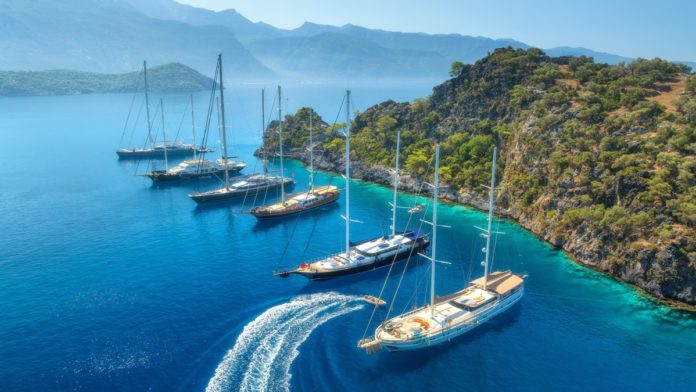
If you want absolute predictability in your vacation spend, wind-powered vessels are the clear winners. Modern luxury catamarans offer living spaces that rival motor yachts while keeping fuel bills negligible.
- Best for: Groups of 4–10 guests, island chains where destinations are close together (like the BVI or the Cyclades), charterers who genuinely enjoy the romance of sailing, families wanting exceptional stability and wide-open deck space, and anyone who wants to avoid unexpected APA surprises. Read also: Solar Panels on Yachts: Pros & Cons
When a motor yacht still makes sense and how to protect your budget
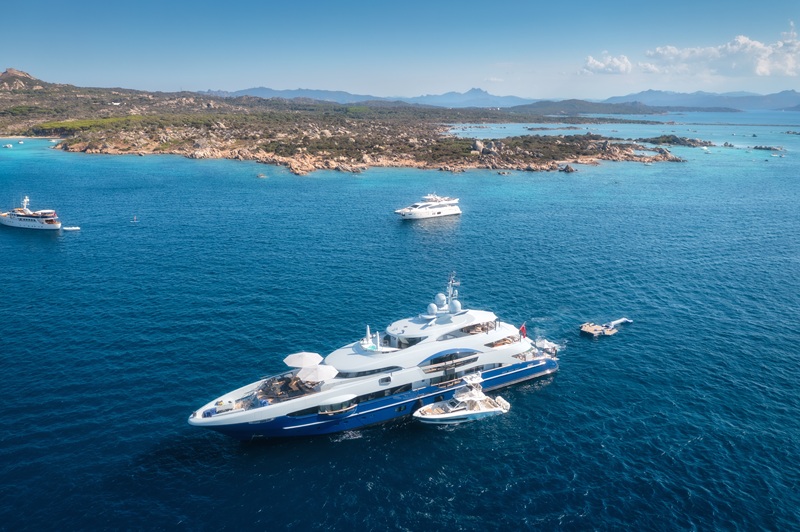
Motor yachts remain the gold standard for luxury, speed, and uncompromising volume. You don’t have to abandon them completely, but you do need to adjust your approach.
- Best for: Destinations with massive distances between stops (like the Bahamas or the expansive outer islands of the Adriatic), guests who prioritize speed and interior space over the sailing experience, and groups where comfort trumps tight budgeting.
- Mitigation tactics if you go motor:
- Choose a smaller or more modern, fuel-efficient hull design (such as a displacement hull rather than a planing hull).
- Explicitly ask your broker to estimate the APA based on current, real-time local diesel prices rather than last year’s outdated averages.
- Plan an itinerary that involves anchoring out in pristine bays more often than cruising at top speed.
- Coordinate with the captain to limit generator hours by utilizing shore power where available or opting for yachts equipped with modern lithium-ion battery banks.
Match your charter destination to your country of residence to avoid flights disruptions
The smartest way to de-risk your holiday is to eliminate complex travel logistics. By keeping your charter within a single region, you avoid long-haul flights over volatile air corridors, reduce fuel surcharges, and simplify your transit.
If you’re American: the Caribbean and the Bahamas remain your best bets
The Caribbean basin and the Bahamas offer stable fuel networks, predictable pricing, and short, direct flight paths from the US mainland. You completely sidestep transcontinental overflight complications.
If you’re European: the Mediterranean is usually the right call
With classic hubs like the French Riviera, Amalfi Coast, Greece, and Croatia practically in your backyard, European charterers have no reason to cross oceans. The infrastructure is robust, and regional travel remains highly efficient.
If you’re Asian: Southeast Asia and the Pacific are your natural arena
Exploring Thailand’s dramatic karsts, Indonesia’s remote archipelagos, or the isolated luxury of French Polynesia allows you to stay well clear of Western and Middle Eastern market disruptions. Fuel networks here are structurally insulated from European energy shocks. Read also: The Best Sailing Destinations in Southeast Asia
The adventurous option: destinations that will be emptier and potentially cheaper because everyone else is nervous
For the contrarian traveler, widespread market anxiety presents a rare opportunity. When the general public pulls back from certain regions due to proximity narratives, luxury destinations that are actually entirely safe can experience softer demand.
If you are willing to look closely at the map, regions like the Maldives or the Seychelles—and even specific, peaceful pockets of the wider Middle East far removed from conflict zones—remain fully operational. Because crowds may thin out, savvy charterers can find better yacht availability, more flexible booking terms, and highly motivated crews eager to secure charters. Read also: Best Seychelles Sailing Itineraries for 7, 11 & 14 Days
Cancellation insurance: the protection most charterers should not underestimate in 2026
Booking a luxury charter requires a substantial financial commitment. In today’s landscape, going unprotected is a gamble you don’t need to take.
What standard charter cancellation insurance covers and doesn’t cover
Standard MYBA or FYBA charter insurance policies protect you against unexpected medical emergencies, severe weather (like hurricanes), or the sudden breakdown of the vessel. However, they almost universally contain war, terrorism, and geopolitical risk exclusions. If you decide to cancel simply because a nearby region becomes unstable or flight paths change, a standard policy will leave you empty-handed.
The Cancel For Any Reason clause: is it worth it in 2026?
The Short Answer: Yes, absolutely.
A Cancel For Any Reason (CFAR) rider is the ultimate peace-of-mind tool. While it adds a premium to your insurance costs and typically must be purchased within 14 days of making your initial deposit, it does exactly what it says on the tin. If you feel uncomfortable with the global landscape two weeks before your trip, you can pull the plug and recoup 50% to 75% of your non-refundable trip funds—including your APA.
Quick-reference guide: which choices protect you most in a disrupted market
| Decision | Lower-risk choice | Higher-risk choice | Why it matters now |
| Boat type | Sailing catamaran or monohull | Large motor yacht | Fuel costs are the most volatile APA element; sailing avoids them entirely. |
| Destination (American) | BVI, USVI, Grenadines | Bahamas (high tax), Middle East | Short flights, no overflight risk, highly stable local fuel supply. |
| Destination (European) | Greece, Croatia, Sardinia, French Riviera | Arabian Gulf, Red Sea | The Med is stable and secure; the Gulf/Red Sea is operationally risky for leisure. |
| Destination (Asian) | Thailand, Indonesia, French Polynesia | Long hauls over disrupted airspace | Short regional flights keep travel costs predictable; regional fuel markets are less exposed. |
| Insurance | CFAR policy (purchased within 14 days of deposit) covering full trip value | No insurance, or standard policy with war exclusions | Geopolitical fluctuations and personal comfort shifts won’t be covered by standard policies. |
What to remember before you book your next charter
The world may be volatile, but the water remains a sanctuary. Navigating a successful charter this season simply requires switching from autopilot to active planning. By selecting the right hull type, aligning your destination with your home market, and securing comprehensive insurance, you can insulate your luxury vacation from global noise. Rely heavily on a trusted broker, ask hard questions about fuel assumptions, and choose wind power when predictability is your priority.
FAQ: Yacht Charters, Fuel Costs, and 2026 Geopolitical Disruption

Will my charter cost more because of rising oil prices?
The base charter rate of the yacht will remain exactly what is stated in your contract. However, if you choose a motor yacht, your total end-of-week cost could be higher because your Advanced Provisioning Allowance (APA) will be spent faster at the fuel dock. Sailing yachts are largely insulated from this.
Is it safe to charter in the Mediterranean right now?
Yes, entirely. The Mediterranean—including classic hotspots like France, Italy, Croatia, and Greece—is completely stable and far removed from active shipping disruptions. It remains a top-tier recommendation for safe luxury charters.
What type of yacht should I choose if I want to avoid surprise costs?
A luxury sailing catamaran or a sailing monohull is your best defense against surprise expenses. They rely on wind for propulsion, meaning your fuel consumption—and consequently, your final APA bill—remains low and completely manageable.
Does cancellation insurance cover me if geopolitical events affect my charter?
Standard policies will not cover cancellations driven by geopolitical events or airspace changes. To protect yourself against these specific risks, you must secure a Cancel For Any Reason (CFAR) policy or a specialized rider within the first two weeks of booking.
Are there any destinations that are actually cheaper or less crowded because of the current disruption?
Yes. Indian Ocean destinations like the Maldives and the Seychelles, as well as peripheral areas in the broader region, may see softer demand due to travelers being overly cautious about long-haul routes. This can translate into better yacht availability and more negotiable terms.
Should I book now or wait to see if prices come down?
Waiting rarely pays off in the luxury yacht market, as premium vessels book up months in advance regardless of global economic conditions. The smarter play is to book early to secure the best boat, but strategically choose a fuel-efficient or wind-powered vessel and safeguard your investment with CFAR insurance.