
Yes, a yacht can cross the Atlantic, but not just any yacht.
Every winter, hundreds of sailing boats and long-range motor yachts make the trip between Europe and the Caribbean, while many other boats, some of them very expensive, would never make it to the other side. Here is what separates the two, with our pick of sailing and motor yachts built for the crossing, the size and range you really need, and the routes they take.
Can a yacht cross the Atlantic? The short answer
A yacht can cross the Atlantic if it is designed for open ocean and carries enough fuel, water, and food for the longest leg. In practice, that means four things:
- An offshore design: CE design category A (“ocean”), the European rating for boats built to handle winds above force 8 and waves above 4 metres
- Enough range for the longest leg: about 2,700 nautical miles nonstop on the classic trade-wind route from the Canaries to the Caribbean, or about 1,800 miles between Bermuda and the Azores on the northern route
- Reliable, redundant systems: engine, steering, rig, water-making, and communications you can repair at sea
- A competent crew: people who have done multi-day passages, night watches, and offshore navigation
Most well-built cruising sailboats meet these criteria. Most motor yachts do not: a typical planing motor yacht has a range of a few hundred miles, which is why they cross on the deck of a cargo ship rather than under their own power. The yachts below are the exceptions.
Best yachts to cross the Atlantic: our selection
| Yacht | Type | Length | Why it works for an Atlantic crossing |
|---|---|---|---|
| NEEL 51 / NEEL 52 | Sailing trimaran | 15.6 m / 15.9 m | Fast (200+ mile days), stable, protected helm, room for a big crew |
| Outremer 5X / Outremer 52 | Performance catamaran | 18 m / 15.7 m | Double-digit speeds, built for short-handed offshore sailing |
| Hallberg-Rassy 57 | Bluewater monohull | 17.4 m | Robust Swedish build, protected centre cockpit, 200-mile days |
| Amel 50 | Bluewater monohull | 15.5 m | Designed for long-distance cruising with a couple on board |
| Nordhavn 52 | Long-range trawler | 16.6 m | Builder-quoted range of about 3,000 to 3,500 nm at economical speed |
| Krogen 52 | Long-range trawler | 52 ft class | Full-displacement hull, builder-quoted range of about 3,300 nm at 7 knots |
Two of the yachts on this list are no longer built new: the Outremer 5X (last hull delivered in 2023) and the NEEL 51, replaced by the NEEL 52. Both remain excellent choices on the used and charter market, which is why we kept them alongside their successors.
Best sailing yachts for an Atlantic crossing
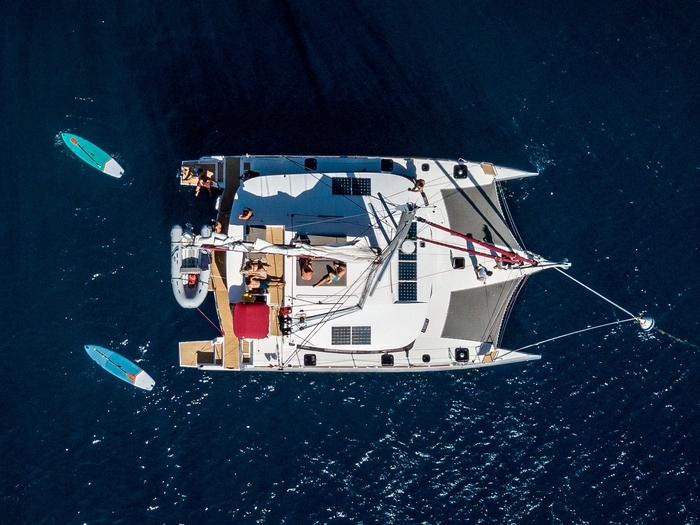


Sailing yachts make up the vast majority of private Atlantic crossings, because the wind does the work and fuel only matters for calms and manoeuvres. The real choice is between a monohull, a catamaran, and a trimaran, and each of the boats below represents the best of its category.
NEEL 51 and NEEL 52: the fast, comfortable trimaran
The NEEL 51 is a 15.6-metre trimaran that combines speed and space: double-digit speeds, 200-mile days, and four to seven cabins. Trimarans are often more sea-kindly than catamarans in waves and chop, and they don’t heel like monohulls, which makes a big difference over two or three weeks at sea. A protected helm station keeps the watch dry and gives good visibility, and the 600-litre diesel and 600-litre water tanks are generous for a boat this size.
The NEEL 51 has since been replaced by the NEEL 52 (15.9 m), drawn by Marc Lombard, with a higher-freeboard central hull, slimmer floats to reduce pitching, and an optional Performance version with a taller carbon rig. Both are rated CE category A.
More info about our Neel 51 available for charter
Outremer 5X and Outremer 52: high-speed catamaran sailing
The Outremer 5X is an 18-metre performance catamaran and one of the fastest cruising multihulls ever built. Four helm stations, a cockpit that seats a dozen people, and a layout designed for a small crew made it a favourite for fast ocean passages. Production ended in 2023, so you’ll find it on the brokerage and charter market rather than new.
For a new boat, the Outremer 52 (15.7 m, designed by VPLP) carries the same philosophy: daggerboards, wave-piercing bows, three or four cabins, and double-digit speeds on a reach in a moderate breeze. Like the 5X, it is built to cross oceans with a couple or a small crew.
Hallberg-Rassy 57: the sturdy bluewater monohull
Hallberg-Rassy builds some of the toughest cruising yachts in the world, and the 57 (17.4 m, designed by Germán Frers) is one of its large bluewater models. Monohulls won’t match multihull top speeds, but the 57 can still log 200-mile days, and many offshore sailors prefer the motion and the feedback of a well-designed monohull in heavy weather.
The protected centre cockpit, the clear deck layout with controls led to the helm, and 1,050 litres of fuel make it a true long-distance boat, still in production today.
Amel 50: built for couples crossing oceans
Amel has a long tradition of yachts designed to be sailed around the world by two people, and the Amel 50 (15.5 m, three cabins, CE category A) follows it. Its systems are designed to be simple and accessible, the cockpit is sheltered, and much of the sail handling is electric, which matters when one person is on watch at 3am in mid-Atlantic. It’s a strong choice if you want a monohull a little smaller and easier to handle than the Hallberg-Rassy 57.
Monohull, catamaran or trimaran: which is best for an Atlantic crossing?
There is no single right answer, but the trade-offs are clear.
A monohull heels and rolls more, but it is the proven bluewater choice and recovers from a knockdown.
A catamaran sails flat, offers more living space, and is usually faster downwind, which suits the trade-wind route perfectly, as long as the crew respects its sail-reduction limits.
A trimaran combines speed with a gentler motion than many catamarans, but there are fewer models to choose from. A common misconception is that catamarans aren’t suitable for ocean crossings: multihulls are now a common sight in every transatlantic rally.
Motor yachts that can cross the Atlantic
Crossing the Atlantic under power is a different exercise: there is no wind to fall back on, so everything comes down to range. A motor yacht that can do it is almost always a full- or semi-displacement passagemaker, built to cruise slowly and efficiently, not a fast planing yacht.
How much range does a motor yacht need?
Start from the longest leg of your route and add a safety margin of at least 50%, to cover headwinds, detours, and generator use. That gives a simple rule of thumb:
- Northern route via Bermuda and the Azores (longest leg about 1,800 nm): plan for at least 2,700 nm of range
- Southern route from the Canaries to the Caribbean (about 2,700 nm nonstop): plan for 4,000 nm or more
This is why most private motor yachts that cross on their own take the northern, island-hopping route, and why range figures should always be checked at the speed you actually intend to run.
Nordhavn 52: a proven ocean passagemaker
Nordhavn is the reference brand for private ocean crossings under power, and the Nordhavn 52 (16.6 m, built since 2009) is one of its most popular models. With about 6,600 litres (1,740 US gallons) of fuel, the builder quotes a range of roughly 3,000 to 3,500 nautical miles at economical speed, around 8 knots. High bulwarks, a Portuguese bridge in front of the wheelhouse, and a stand-up engine room are all features designed for long offshore passages.
Krogen 52: slow, steady, and long-legged
Kadey-Krogen trawlers (now sold as Krogen Yachts) are built around full-displacement hulls designed for comfort and economy at sea. The Krogen 52 carries about 5,300 litres (1,400 US gallons) of fuel, and the builder announced a range of around 3,300 nautical miles at 7 knots with the single-engine set-up. Watertight doors on the pilothouse and a heavy, seakindly hull make it a serious candidate for the northern route.
Can superyachts cross the Atlantic?
Large superyachts and explorer yachts cross every year: many charter yachts spend the summer in the Mediterranean and the winter in the Caribbean. The usual pattern is to leave the western Mediterranean in late November, refuel in Gibraltar and the Canary Islands, and ride the trade winds to the Caribbean. That trip is about 4,000 nautical miles, roughly two weeks at 12 knots, and closer to three weeks once you add waiting for the right weather window. They return in April or May, via the Azores.
Smaller or faster motor yachts that lack the range don’t make the trip under their own power: they are shipped on specialised yacht-transport vessels. If you’re buying a motor yacht with a transatlantic project in mind, the question to ask is not “can it cross?” but “what is its range at 8 to 10 knots, with what reserve?”
What size yacht do you need to cross the Atlantic?
There is no legal minimum size, and some remarkably small boats have crossed the Atlantic. But a record attempt and a comfortable crossing with friends are not the same thing. For a cruising crew, size matters for three reasons: the amount of water, food, and fuel you can carry for two to three weeks; the comfort of the motion and the space for off-watch crew to sleep; and the speed, since a longer waterline means more miles per day.
In practice, many cruising sailors consider 40 feet (about 12 metres) a comfortable starting point for a crew of four, and the boats in our selection, between 15 and 18 metres, offer a real margin of comfort and safety. More important than length, though, are the build quality and the CE category A rating. A well-prepared 40-footer is a better ocean boat than a poorly maintained 60-footer.
What does a yacht need for an Atlantic crossing?

Rallies and races publish strict equipment lists and send inspectors to check every boat. If you cross on your own, nobody checks anything: the skipper carries the whole responsibility. You’ll be thousands of miles from the nearest shore-based rescue, for several weeks, so the boat must be checked from stem to stern. Plenty of older boats are perfectly capable of the trip, and not every new boat is.
The non-negotiables
- A sound hull and rig, with the standing rigging inspected and the sails checked by a sailmaker
- A reliable engine, to escape calms or dodge bad weather
- Enough food and water for the crew, with a margin, plus a watermaker or reserve tanks
- Access to current weather forecasts throughout the crossing
- Spare parts and tools for the most common repairs
Safety and communication equipment
- An EPIRB satellite rescue beacon
- Long-range communications: satellite phone or satellite internet, and ideally an SSB radio
- A certified life raft with space for every crew member
- Storm sails, and a drogue or sea anchor
- Lifejackets with harnesses, jacklines, and personal AIS beacons for night watches
Read also: 10 Sailing Myths And Bad Advice You Shouldn’t Listen To
Atlantic crossing routes, timing, and how long it takes
Where and when you cross matters as much as what you cross on, because the Atlantic has a clear seasonal pattern.
Westbound: Europe to the Caribbean
The classic route runs from the Canary Islands to the Caribbean, following the trade winds: about 2,700 nautical miles, the route of the ARC rally from Las Palmas to Saint Lucia. Most cruising sailboats take 18 to 21 days. Boats leave from late November onwards, once the Atlantic hurricane season (June 1 to November 30) is over and the trade winds settle in for December and January.
Eastbound: the Caribbean back to Europe
The return trip is usually made in April or May, heading north to Bermuda, then east to the Azores (about 1,800 nautical miles), and on to Portugal or Gibraltar. The winds are less predictable than on the trade-wind route, so weather routing becomes even more important.
Read also: The Caribbean To Mediterranean Sailing Routes: How To Cross The Atlantic Eastward
What experience do you need to cross the Atlantic?


An Atlantic crossing is a major milestone, not a first trip. Beginners belong on board only alongside an experienced crew or a qualified captain.
To skipper your own crossing, you need real experience of multi-day nonstop passages: sailing at night, standing watches, navigating offshore, provisioning for weeks, and troubleshooting the engine and onboard systems. At sea, there’s no place to park, and every problem has to be solved on the spot.
Crossing the Atlantic without your own yacht: charter and crew options
You don’t need to own a yacht to cross the Atlantic. Every autumn and spring, charter yachts reposition between the Mediterranean and the Caribbean, and some take guests or crew members on board for the passage. With a professional captain and first mate in charge, you can stand watches and take part in the sailing, which is one of the best ways to gain real offshore experience.
Many yachts are also available for charter with a skipper for rallies, races, or deliveries. You come back with the miles, the confidence, and often enough experience to skipper your own boat on the next crossing.
Choosing the right yacht for your Atlantic crossing
The best yacht to cross the Atlantic is one built for the open ocean, with enough range for the longest leg and a crew that knows how to sail it. Under sail, a bluewater monohull like the Hallberg-Rassy 57 or the Amel 50, or a fast multihull like the NEEL or the Outremer, will get you across in two to three weeks. Under power, only true long-range passagemakers such as the Nordhavn 52 or the Krogen 52 can do it on their own. Whatever you choose, preparation does the rest. If you’d like to try an ocean passage before committing to a boat, our team can help you find a yacht and a crew for your first crossing.
FAQ: Crossing the Atlantic by Yacht
Yes, but only long-range displacement or semi-displacement motor yachts, such as Nordhavn or Krogen trawlers, or large superyachts. Most private motor yachts take the northern route via Bermuda and the Azores, where the longest leg is about 1,800 nautical miles. Faster planing yachts usually lack the range and are shipped across instead.
Yes. Ocean-rated catamarans (CE category A) cross the Atlantic every year, and they are especially well suited to the downwind trade-wind route from the Canaries to the Caribbean. Performance catamarans such as the Outremer range are designed precisely for this kind of passage.
On the classic route from the Canary Islands to the Caribbean (about 2,700 nautical miles), most cruising sailboats take 18 to 21 days. A superyacht cruising at 12 knots needs about two weeks from the western Mediterranean to the Caribbean, plus time to wait for the right weather window.
There is no legal minimum, and very small boats have crossed. For a comfortable and safe crossing with a cruising crew, many sailors consider around 40 feet (12 metres) a sensible starting point. Build quality, a CE category A rating, and preparation matter more than length alone.
Westbound, from Europe to the Caribbean, from late November to January, after the hurricane season and when the trade winds are established. Eastbound, from the Caribbean back to Europe, in April or May, usually via Bermuda and the Azores.
Yes. Many charter superyachts cross twice a year, spending the summer in the Mediterranean and the winter in the Caribbean. They usually refuel in Gibraltar and the Canary Islands on the way west and return via the Azores in spring.
Not as a skipper. But you can join a crossing as a crew member on a yacht with a professional captain, or charter a skippered yacht for the passage. It is one of the best ways to build offshore experience.