
The debate between trimarans and catamarans has been raging for years, with no clear victor in sight.
If anyone can notice that a trimaran has three hulls while a catamaran only has two, many are confused about what it changes when you are actually sailling or using any of the these vessels..
In this article, we’ll detail the main differences between a catamaran and a trimaran when it comes to sailing but also living and spending time on them.
The summary of the battle between Trimaran and Catamaran
| Criteria | Trimaran | Catamaran |
|---|---|---|
| Design | Three hulls for enhanced stability and performance. | Two hulls providing spacious living areas. |
| Performance | Superior speed and efficiency, especially in headwinds. | Generally slower than trimarans but stable in calm conditions. |
| Stability | Excellent stability with a righting moment of 27°. | Good stability but lower righting moment of 12°. |
| Safety | Less likely to capsize, with buoyancy tanks for added security. | Stable but more prone to capsizing in rough seas compared to trimarans. |
| Living Space | Offers comparable living space but typically less than catamarans. | Known for luxurious and spacious interiors, ideal for family cruising. |
| Ideal Use | Best for racing and performance sailing; suitable for adventurous sailors. | Ideal for leisurely cruising and family outings; comfortable for long trips. |
| Cost | Generally more expensive due to advanced design and materials. | Prices vary widely; often more affordable options available. |
| Popularity | Gaining traction in racing and adventure sailing markets | Continues to be popular for recreational cruising and luxury markets. |
Performance and Stability: two distinct sailing experiences
The stability of a catamaran vs the slight heel of a trimaran
Stability feels very different between a catamaran and a trimaran.
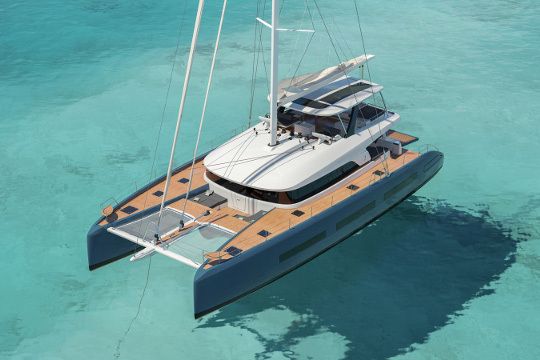
A catamaran offers incredible initial stiffness: it resists heeling almost entirely, staying flat like a dining table. This is comfortable for beginners, tend to reduce sea-sickness and rock-solid at anchor to the point where you might feel in an appartment. But the motion in choppy waves can be snappy and jerky.
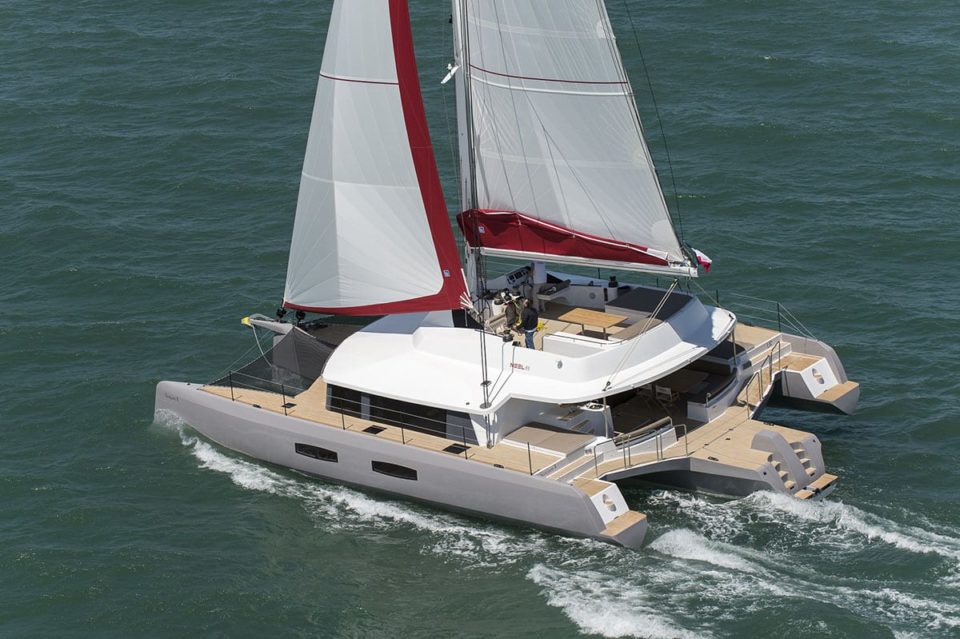
A trimaran, however, relies on its outer hulls (amas) for balance. It will heel gently until the leeward ama digs into the water, then lock in and ride smoothly like it is on rails. This slight tilt gives the sailor valuable feedback on wind power, whereas a flat-sailing catamaran can hide how stressed the rig is until it’s too late.
At anchor, the catamaran wins: a trimaran can sometimes “waddle” gently from side to side, while the cat sits completely still.
But sailing? To each their own. Trimaran feels closer to what you would expect on a monohull. So if you like the feeling of heeling on a monohull, you won’t be lost on a trimaran.
Read also : Trimaran our ultimate guide
The wind and its influence on the performance of a catamaran vs a trimaran
A trimaran, with its sleek main hull and deep centerboard, creates very little drag and can point almost as close to the wind as a performance monohull.
In contrast, a cruising catamaran often struggles to sail tight angles upwind.
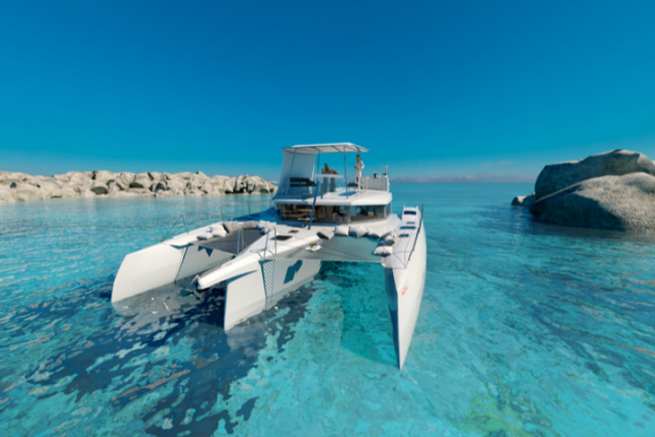
The high bridge deck and wide living space on a cat create significant “windage” acting like a wall that the wind pushes against, which slows you down and increases leeway (sliding sideways).
If your destination is directly upwind, the trimaran will get you there much faster and more efficiently.
However, once you crack off and sail with the wind behind you, both boats light up and offer excellent speed. Just remember that the generally heavier catamaran often needs a bit more wind pressure to start moving than the lightweight, easily-driven trimaran.

Catamarans vs trimarans surface: different living spaces
If sheer volume is your priority, the catamaran wins, hands down.
It offers a massive, square platform where the cockpit flows seamlessly into a wide, bright salon with 360-degree views. Because the cabins are separated into the two hulls, you get excellent privacy for guests and enough storage for a modern lifestyle.
A trimaran, on the other hand, lives more like a traditional monohull. You are confined to the central main hull, which can feel somewhat narrow or tunnel-like compared to the expansive cat. The outer hulls (amas) are generally used only for storage, not living, so you lose that feeling of width once you go below decks.
For a family of four, a 40-foot cat feels like an apartment, while a 40-foot tri feels like a cozy, performance-oriented cruiser.
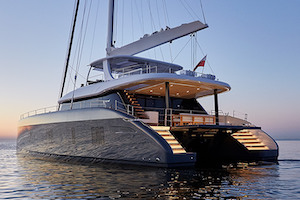
So yes, no surprise why the cats have been taking the world’s oceans by storm with their ever-expanding sizes and luxurious designs. Boats like the majestic Lagoon Seventy 7, Allegria 67 from Fountaine Pajot, or Sunreef Power 70 are prime example of why catamarans are very popular these days.
But don’t discard trimarans too fast either.
Trimarans such as DragonFly boast amazing features thanks to its “Swing Wing” system while Rapido Trimaran offers “an experience like nothing else” thanks in part due to Morrelli & Melvin architect firm constructing this Vietnam built masterpiece!
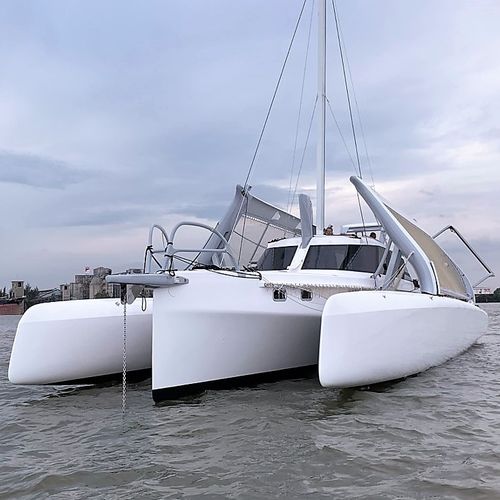
Likewise, the trimarans from shipyard NEEL are second to none!
These vessels feature ‘Cockloon®’ areas which seamlessly connect saloons and cockpits, providing uninterrupted living spaces with breathtaking panoramic views. Alongside this is an expansive flybridge offering extra room along with comfortable cabins nestled within their own designated floats for ultimate relaxation.
The NEEL 65 is for instance a perfect blend of stability, performance and living space. A unique trimaran that boasts roomy cabins thanks to its enlarged volume. Not only does it offer more living area compared with typical catamarans, but it also features an optimally aligned central hull which provides extra safety at anchor! So if you’ve been in two minds between catamarans and trimarans perhaps this could sway your decision once and for all…
Trimaran vs catamaran safety: the width of trimarans makes them safer
Both vessels are generally hard to sink due to positive buoyancy, meaning they float even if filled with water.
That being said, the trimaran stands out as the most secure of its multihull contemporaries.
Its superior design consisting of three hulls, effective anti-drift strategies and centre-mounted weights combined to provide it with a groundbreaking 27° righting moment, allowing for excellent stability in even gusty weather or choppy waters.
In comparison, catamarans offer just 12° degrees protection against capsize, meaning that the trustworthiness offered by a trimaran is hard to match!
Further punctuating this remarkable level of security are features such as buoyancy tanks which ensure that if capsizing does occur, sinking will not be an issue: making trimarans perfect vessels for sailing’s safety conscious connoisseurs.
Racing: trimarans are clear winners over any catamarans
In the last decade, trimarans have surged in popularity for racing purposes due to their enhanced speed and safety capabilities.
Their stability on rough seas allows them to be pushed further than catamarans can go without sacrificing control of the vessel: this is why most multihull races since 2010 have been captured by a trimaran!
The Jules Verne Trophy has not seen any different: all winners since its start in 2010 are proud owners of these three-hulled vessels.
How to make the right choice between a monohull, a catamaran, and a trimaran?
If you are unsure whether you should pick a monohull, a catamaran or a trimaran, here is what you might want to consider.
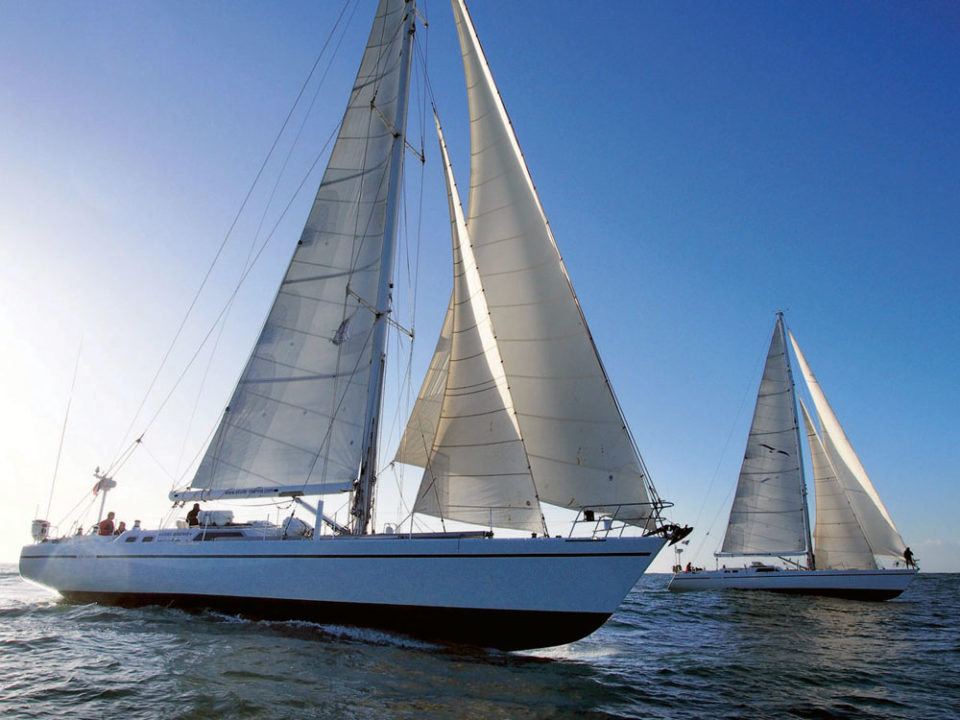
Choose a monohull sailboat if you like sailing!
If your primary joy comes from the act of sailing itself, don’t discard sailboats too fast!
A cruising monohull offers the classic romantic experience: the boat heels, digs in, and finds a rhythm with the sea that feels alive.
A trimaran is often called the “sailor’s multihull” because it keeps that tactile feedback: you feel the acceleration and the boat responds instantly to the wheel, much like a fast dinghy.
In contrast, a production catamaran can sometimes feel like driving a bus. The helm is often numb, and the sensation of speed is dulled by the boat’s mass and stability.
If you want to actually drive the boat rather than just monitor the autopilot while drinking coffee, a monohull (or a trimaran) will put a much bigger smile on your face.
Read also : Monohull vs Catamaran, which one to choose?
Pick a catamaran if you like volume and calm seas
If your sailing dream involves hosting dinner parties, carrying a kayak collection, and sleeping in a queen-sized bed, the catamaran is the clear winner.
The sheer volume is unmatched: you aren’t just living in the boat, you are living on it with expansive 360-degree views.
It creates a calm, stable platform that completely eliminates the constant struggle against gravity found on leaning boats like monohulls or trimarans. This stability is a game-changer at anchor, which is where cruisers actually spend 90% of their time.
You can cook a full meal without chasing ingredients across the counter, and nervous guests or non-sailors will immediately feel safe.
While the motion can be snappy in rough water, in fair trade winds and quiet bays, a catamaran offers a level of relaxation and comfort that no other vessel can touch. And let’s be real, most people charter a catamaran to sail calm waters, not to do a transatlantic!
Pick a trimaran for a good combination of volume and performances
A trimaran strikes a unique balance, offering a “best of both worlds” compromise for the performance-minded cruiser.
It delivers exhilarating speed and the ability to point high into the wind, often leaving both monohulls and heavy cruising cats in its wake. This speed isn’t just for fun: it is a safety feature that lets you outrun weather systems or reach shelter before dark.
Inside, while you won’t find the ballroom space of a catamaran, you gain significantly more light and width than a cramped monohull. The main hull offers a secure, cozy apartment feel, while the expansive deck nets provide massive outdoor real estate for relaxing.
If you want to arrive at the anchorage first without sacrificing all your creature comforts, the trimaran is your vessel.
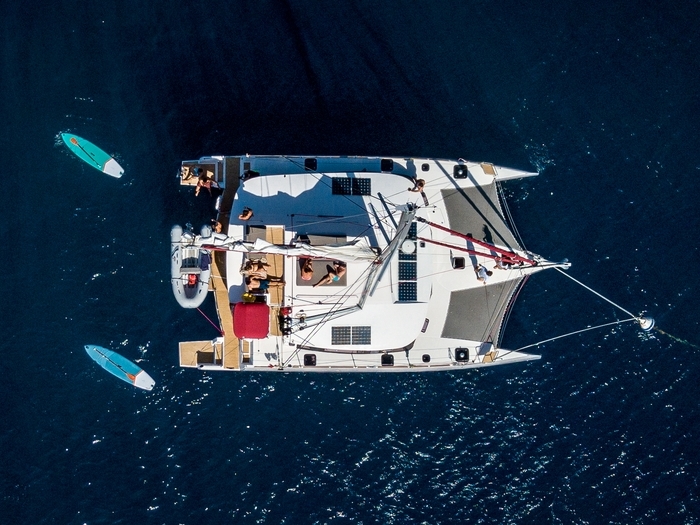
Enjoy cruising on the NEEL 51, a unique charter yacht that offers plenty of space without sacrificing performance. This trimaran-inspired vessel is perfect for travelers who want to explore new destinations quickly and safely, with speeds twice as high as other similar boats!
Read more: LEEN 72′: The Future of Hybrid Trimarans is Here.
Conclusion
After looking into the differences between catamarans and trimarans, we can conclude that they each offer distinct sailing experiences.
Catamaran sails offer a sense of comfort and stability for extended cruising trips and luxurious living spaces, while trimarans are better on performance, safety and speed when racing.
Ultimately though, it all comes down to personal preference and most of our clients are glad regardless of the little trade-off that have been made either way.
Feel free to get in touch with us if you want to charter a catamaran or a trimaran and we’ll hook you with the best ones depending on your needs.
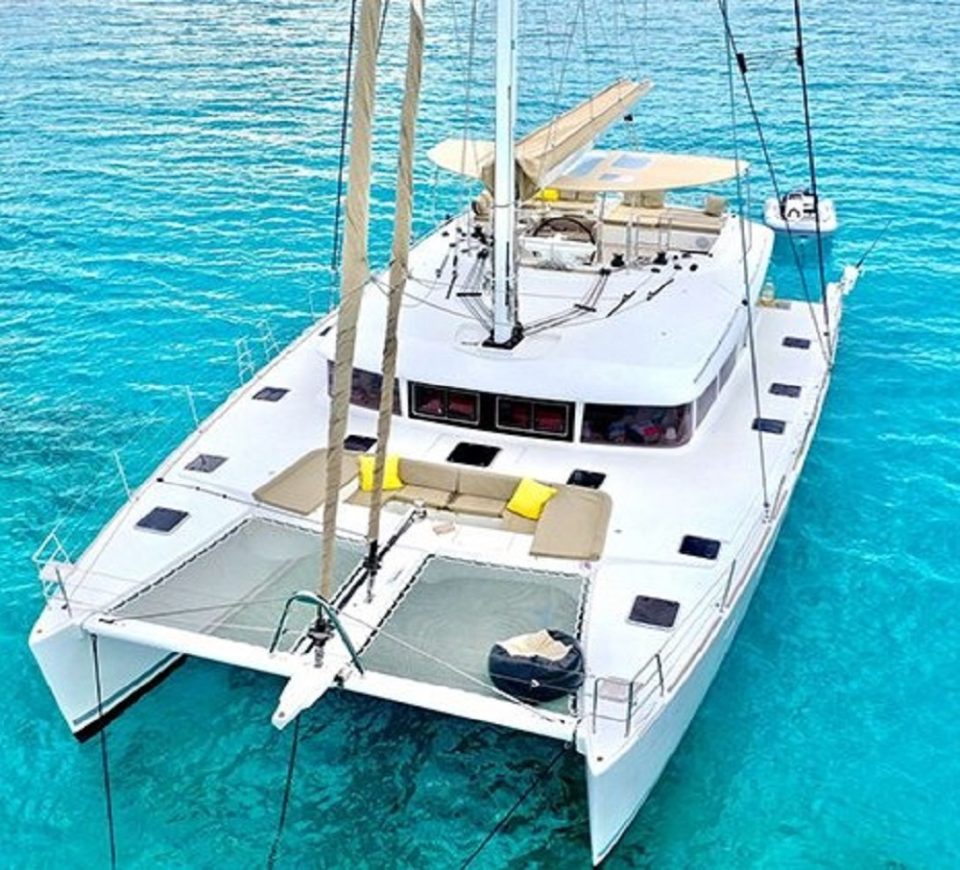
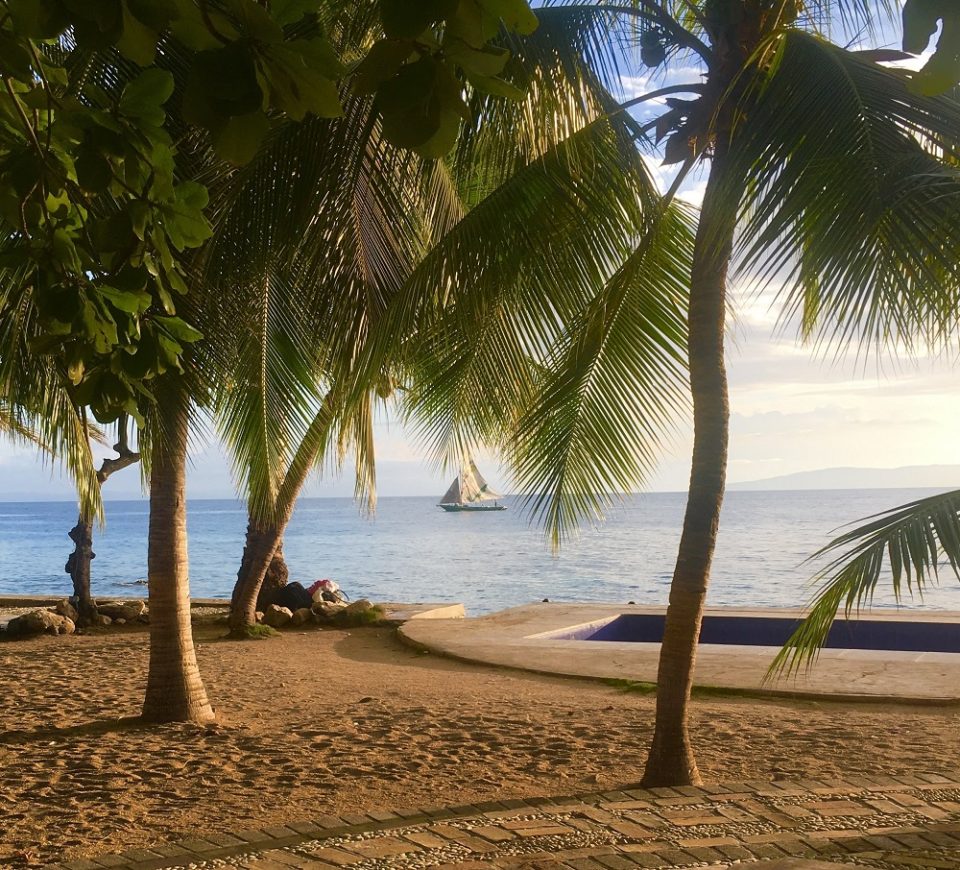
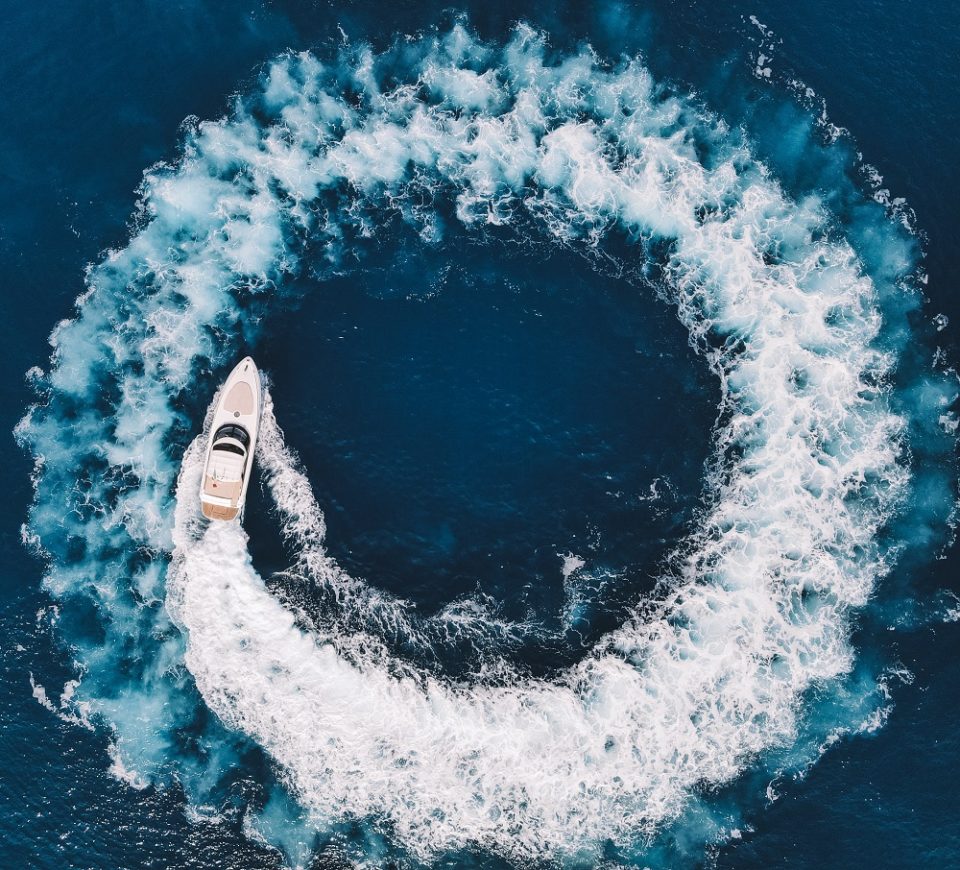
Whether you’re a fan of stability or speed, there’s one boat that can give you both – the trimaran vs catamaran. Catamarans provide plenty of living space and comfort in calm waters but struggle with choppy seas, while modern trimarans deliver excellent performance even on rough days yet still offer good room to relax onboard. But if vintage sailing is more your style opt for an older-style tri since it won’t be equipped with as much creature comforts!
Catamarans and trimarans are two types of watercraft that rapidly cut through the waves, but when it comes to speed one stands out above the rest. Trimarans have gained a reputation for being fast enough to take on any other vessel in a race – making them an excellent choice for anyone looking to shave precious seconds off their time!
When it comes to safety on the sea, two of the most popular vessels are Trimarans and Catamarans. Thanks to their side hulls, trimarans offer a much greater heeling angle compared with catamarans – meaning they’re less likely to capsize or sink in rough waters. However don’t let that put you off taking out a catamaran – while not as secure as its three-hulled cousin – these craft still provide plenty of stability for your seafaring adventure!
If you’re looking for an affordable seafaring vessel, the choice between a catamaran or trimaran can be daunting. With numerous factors that impact cost – from age and length to comfort levels and desirability – it’s often hard to tell which of these two sailing vessels will fit your budget best. But with some research, you’ll find just the right combination of affordability and quality suited perfectly to your needs!